
Our first side trip wasn't leaving until 8:00 am so we had plenty of time to enjoy the veranda once more. To our surprise there was an Olive-sided Flycatcher waiting for us when we got there! This is a species that we were all familiar with since it breeds throughout Canada and western North America, but we normally only detect it during fall migration. It winters in northern South America and parts of Central America, so seeing it in Trinidad was perfectly normal, although not a species that we particularly expected to see!
Although we had been in Trinidad for 4 days, we hadn't seen a single woodpecker, and one of my traveling companions was really hankering for a woodpecker siting. Thus, after talking with a few local guides we ended up requesting a last-minute 4 hour side trip up Blanchisseuse Rd. which would put us at a much higher elevation and in the territory of known woodpecker pairs. This trip turned out to be quite productive and provided us with 10 more species for our list...including two species of woodpeckers! The most striking of the woodpeckers was the pair of Chestnut Woodpeckers that flew back and forth over our heads for a bit before disappearing back into the jungle. Unfortunately I was only able to get one terrible, but identifiable photo of this magnificent species. The other woodpecker that we were able to check off our list was the Lineated Woodpecker; however, we were only lucky enough to get a fleeting glance and hear it call.
 |
| Chestnut Woodpecker |
 |
| Common Black Hawk |
 |
| Ornate Hawk-Eagle |
Some other species that we saw and/or heard included Tropical Parula, Plumbeous Kite, Short-tailed Hawk, Gray-lined Hawk, Blue-black Grassquit, and Trinidad Euphonia. Once we got to the highest point on Blanchisseuse Rd. which sits at approximately 1900 ft in elevation, we were greeted by a beautiful view of the northern range with the Caribbean Sea in the background.
We returned to Asa Wright just in time for lunch, and then had about an hour to kill before our bus left for the airport. During this time we visited the veranda one more time and tracked down our guide/driver to arrange for a quick stop at one more place on the way to the airport. I was also able to have a 1 second glimpse of a Golden-Olive Woodpecker that came to visit the veranda!
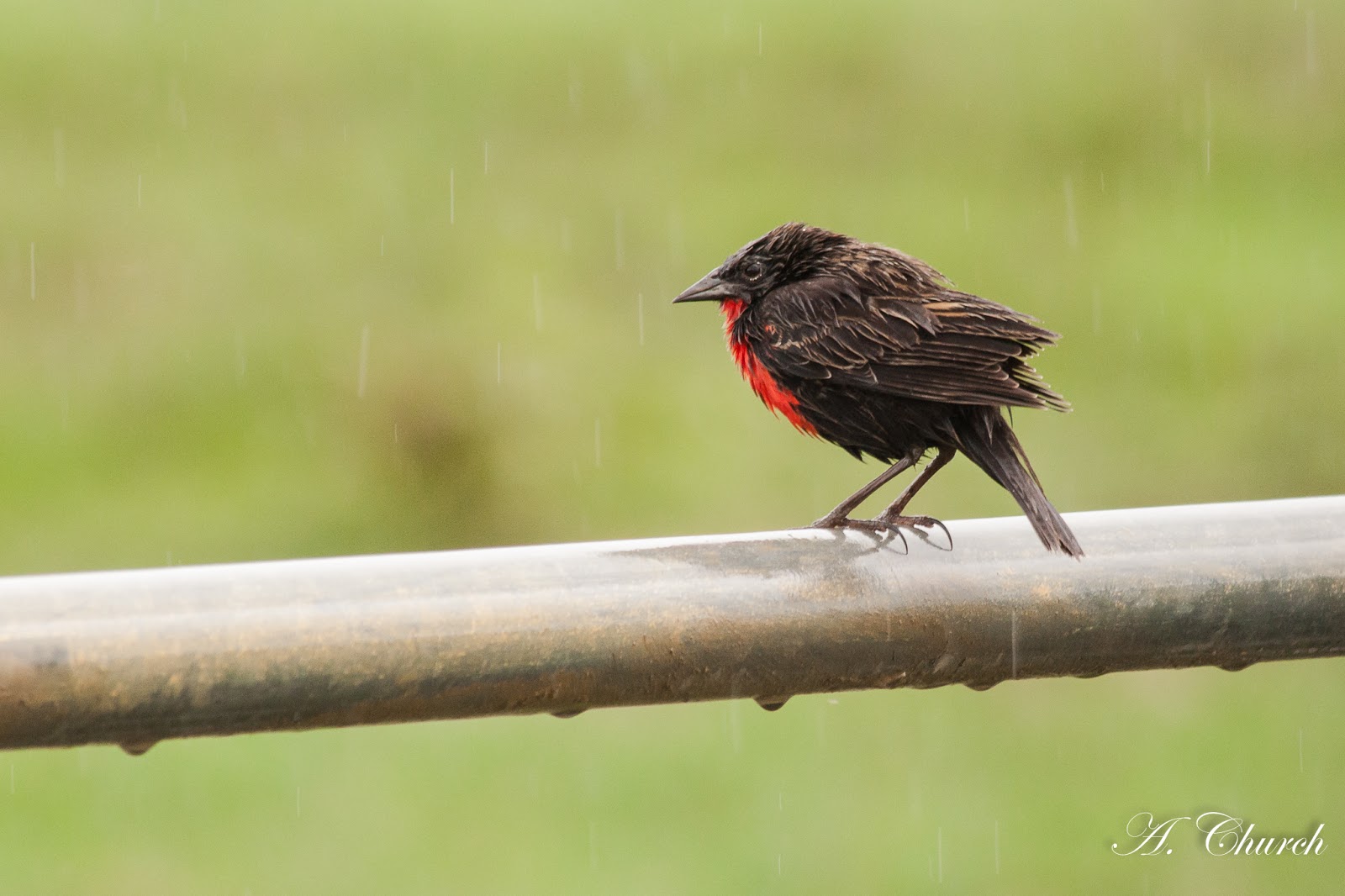
It was finally time to say goodbye to Asa Wright and head to the airport. However, we had one more chance to pick up a few species along the way. We had convinced our driver to make a stop at the Aripo Livestock Agriculture Research Station. Although we ended up birding through a passing thunderstorm we managed to see 12 additional species: Carib Grackle, Red-breasted Meadowlark, Grassland Yellow-Finch, White-winged Swallow, Yellow-bellied Elaenia, Yellow-chinned Spinetail, Green-rumped Parrotlet, Rock Pigeon, Least Sandpiper, Solitary Sandpiper, Spotted Sandpiper, and Savannah Hawk. What a great use of 30 minutes! We also spotted a Ringed Kingfisher, Peregrine Falcon, and Greater Yellowlegs just before we got dropped off at the airport.
Wow! What a trip! Definitely a place to revisit in the near future.
Below is our entire trip list in taxonomic order:
 |
| 1900 ft in elevation. The aqua color in the background is the Caribbean Sea |
 |
| White-bearded Manakin |
 |
| Bay-headed Tanager |
 |
| Female Purple Honeycreeper |
 |
| Savannah Hawk in a downpour |
 |
| Savannah Hawk with his/her sassy pants on. |
 |
| Red-breasted Meadowlark in a downpour |
 |
| Southern Lapwing being sassy |
 |
| Southern Lapwing |
 |
| A young Wattled Jacana |
 |
| Red-breasted Meadowlark |
 |
| Red-breasted Meadowlark |
 |
| Grassland Yellow-Finch |
 |
| Yellow-bellied Elaenia |
 |
| Green-rumped Parrotlet preening after the rain. |
 |
| Green-rumped Parrotlets |
Below is our entire trip list in taxonomic order:
| # | Species | Location | Date |
| 1 | Little Tinamou - Crypturellus soui | Blanchisseuse Road | 10/21/2015 |
| 2 | Anhinga - Anhinga anhinga | Caroni Swamp | 10/19/2015 |
| 3 | Great Egret - Ardea alba | Trincity Sewage Treatment Ponds | 10/19/2015 |
| 4 | Snowy Egret - Egretta thula | Caroni Swamp | 10/19/2015 |
| 5 | Little Blue Heron - Egretta caerulea | Caroni Swamp | 10/19/2015 |
| 6 | Tricolored Heron - Egretta tricolor | Caroni Swamp | 10/19/2015 |
| 7 | Cattle Egret - Bubulcus ibis | Trincity Sewage Treatment Ponds | 10/19/2015 |
| 8 | Striated Heron - Butorides striata | Trincity Sewage Treatment Ponds | 10/19/2015 |
| 9 | Yellow-crowned Night-Heron - Nyctanassa violacea | Caroni Swamp | 10/19/2015 |
| 10 | Scarlet Ibis - Eudocimus ruber | Caroni Swamp | 10/19/2015 |
| 11 | Black Vulture - Coragyps atratus | Asa Wright Nature Centre | 10/17/2015 |
| 12 | Turkey Vulture - Cathartes aura | Asa Wright Nature Centre | 10/18/2015 |
| 13 | Osprey - Pandion haliaetus | Caroni Swamp | 10/19/2015 |
| 14 | Black Hawk-Eagle - Spizaetus tyrannus | Asa Wright Nature Centre | 10/19/2015 |
| 15 | Ornate Hawk-Eagle - Spizaetus ornatus | Blanchisseuse Road | 10/21/2015 |
| 16 | Plumbeous Kite - Ictinia plumbea | Blanchisseuse Road | 10/21/2015 |
| 17 | Long-winged Harrier - Circus buffoni | Caroni Rice Fields | 10/19/2015 |
| 18 | Common Black Hawk - Buteogallus anthracinus | Asa Wright Nature Centre | 10/19/2015 |
| 19 | Savanna Hawk - Buteogallus meridionalis | Aripo Livestock (Agriculture Research) Station | 10/21/2015 |
| 20 | White Hawk - Pseudastur albicollis | Asa Wright Nature Centre | 10/17/2015 |
| 21 | Gray-lined Hawk - Buteo nitidus | Blanchisseuse Road | 10/21/2015 |
| 22 | Short-tailed Hawk - Buteo brachyurus | Blanchisseuse Road | 10/21/2015 |
| 23 | Purple Gallinule - Porphyrio martinicus | Trincity Sewage Treatment Ponds | 10/19/2015 |
| 24 | Southern Lapwing - Vanellus chilensis | Trincity Sewage Treatment Ponds | 10/19/2015 |
| 25 | Wattled Jacana - Jacana jacana | Trincity Sewage Treatment Ponds | 10/19/2015 |
| 26 | Spotted Sandpiper - Actitis macularius | Caroni Swamp | 10/19/2015 |
| 27 | Solitary Sandpiper - Tringa solitaria | Aripo Livestock (Agriculture Research) Station | 10/21/2015 |
| 28 | Greater Yellowlegs - Tringa melanoleuca | Piarco Airport and adjacent lakes | 10/21/2015 |
| 29 | Least Sandpiper - Calidris minutilla | Aripo Livestock (Agriculture Research) Station | 10/21/2015 |
| 30 | Yellow-billed Tern - Sternula superciliaris | Trincity Sewage Treatment Ponds | 10/19/2015 |
| 31 | Large-billed Tern - Phaetusa simplex | Trincity Sewage Treatment Ponds | 10/19/2015 |
| 32 | Rock Pigeon - Columba livia | Trinidad and Tobago | 10/19/2015 |
| 33 | Scaled Pigeon - Patagioenas speciosa | Asa Wright Nature Centre | 10/18/2015 |
| 34 | Ruddy Ground-Dove - Columbina talpacoti | Trinidad and Tobago | 10/19/2015 |
| 35 | White-tipped Dove - Leptotila verreauxi | Asa Wright Nature Centre | 10/18/2015 |
| 36 | Gray-fronted Dove - Leptotila rufaxilla | Asa Wright Nature Centre | 10/17/2015 |
| 37 | Smooth-billed Ani - Crotophaga ani | Caroni Swamp | 10/19/2015 |
| 38 | Ferruginous Pygmy-Owl - Glaucidium brasilianum | Asa Wright Nature Centre | 10/18/2015 |
| 39 | Oilbird - Steatornis caripensis | Asa Wright Nature Centre | 10/20/2015 |
| 40 | Band-rumped Swift - Chaetura spinicaudus | Asa Wright Nature Centre | 10/18/2015 |
| 41 | Gray-rumped Swift - Chaetura cinereiventris | Asa Wright Nature Centre | 10/17/2015 |
| 42 | White-necked Jacobin - Florisuga mellivora | Asa Wright Nature Centre | 10/17/2015 |
| 43 | Rufous-breasted Hermit - Glaucis hirsutus | Asa Wright Nature Centre | 10/20/2015 |
| 44 | Green Hermit - Phaethornis guy | Asa Wright Nature Centre | 10/17/2015 |
| 45 | Little Hermit - Phaethornis longuemareus | Asa Wright Nature Centre | 10/17/2015 |
| 46 | Green-throated Mango - Anthracothorax viridigula | Caroni Swamp | 10/19/2015 |
| 47 | Tufted Coquette - Lophornis ornatus | Asa Wright Nature Centre | 10/17/2015 |
| 48 | Long-billed Starthroat - Heliomaster longirostris | Asa Wright Nature Centre | 10/17/2015 |
| 49 | Blue-chinned Sapphire - Chlorestes notata | Asa Wright Nature Centre | 10/17/2015 |
| 50 | White-chested Emerald - Amazilia brevirostris | Asa Wright Nature Centre | 10/17/2015 |
| 51 | Copper-rumped Hummingbird - Amazilia tobaci | Asa Wright Nature Centre | 10/17/2015 |
| 52 | Green-backed Trogon - Trogon viridis | Asa Wright Nature Centre | 10/18/2015 |
| 53 | Guianan Trogon - Trogon violaceus | Asa Wright Nature Centre | 10/18/2015 |
| 54 | Collared Trogon - Trogon collaris | Asa Wright Nature Centre | 10/18/2015 |
| 55 | Trinidad Motmot - Momotus bahamensis | Asa Wright Nature Centre | 10/18/2015 |
| 56 | Ringed Kingfisher - Megaceryle torquata | Trinidad and Tobago | 10/21/2015 |
| 57 | Channel-billed Toucan - Ramphastos vitellinus | Asa Wright Nature Centre | 10/18/2015 |
| 58 | Chestnut Woodpecker - Celeus elegans | Blanchisseuse Road | 10/21/2015 |
| 59 | Lineated Woodpecker - Dryocopus lineatus | Blanchisseuse Road | 10/21/2015 |
| 60 | Yellow-headed Caracara - Milvago chimachima | Caroni Swamp | 10/19/2015 |
| 61 | Peregrine Falcon - Falco peregrinus | Trinidad and Tobago | 10/21/2015 |
| 62 | Orange-winged Parrot - Amazona amazonica | Asa Wright Nature Centre | 10/18/2015 |
| 63 | Green-rumped Parrotlet - Forpus passerinus | Caroni Swamp | 10/19/2015 |
| 64 | Great Antshrike - Taraba major | Asa Wright Nature Centre | 10/19/2015 |
| 65 | Black-crested Antshrike - Sakesphorus canadensis | Caroni Swamp | 10/19/2015 |
| 66 | Barred Antshrike - Thamnophilus doliatus | Asa Wright Nature Centre | 10/17/2015 |
| 67 | Plain Antvireo - Dysithamnus mentalis | Asa Wright Nature Centre | 10/18/2015 |
| 68 | White-flanked Antwren - Myrmotherula axillaris | Asa Wright Nature Centre | 10/18/2015 |
| 69 | Cocoa Woodcreeper - Xiphorhynchus susurrans | Asa Wright Nature Centre | 10/17/2015 |
| 70 | Straight-billed Woodcreeper - Dendroplex picus | Caroni Swamp | 10/19/2015 |
| 71 | Yellow-chinned Spinetail - Certhiaxis cinnamomeus | Aripo Livestock (Agriculture Research) Station | 10/21/2015 |
| 72 | Yellow-bellied Elaenia - Elaenia flavogaster | Aripo Livestock (Agriculture Research) Station | 10/21/2015 |
| 73 | Ochre-bellied Flycatcher - Mionectes oleagineus | Asa Wright Nature Centre | 10/20/2015 |
| 74 | Olive-sided Flycatcher - Contopus cooperi | Asa Wright Nature Centre | 10/21/2015 |
| 75 | Tropical Pewee - Contopus cinereus | Asa Wright Nature Centre | 10/19/2015 |
| 76 | Pied Water-Tyrant - Fluvicola pica | Trincity Sewage Treatment Ponds | 10/19/2015 |
| 77 | Great Kiskadee - Pitangus sulphuratus | Asa Wright Nature Centre | 10/17/2015 |
| 78 | Boat-billed Flycatcher - Megarynchus pitangua | Asa Wright Nature Centre | 10/20/2015 |
| 79 | Tropical Kingbird - Tyrannus melancholicus | Asa Wright Nature Centre | 10/18/2015 |
| 80 | Bearded Bellbird - Procnias averano | Asa Wright Nature Centre | 10/18/2015 |
| 81 | White-bearded Manakin - Manacus manacus | Asa Wright Nature Centre | 10/18/2015 |
| 82 | Golden-headed Manakin - Ceratopipra erythrocephala | Asa Wright Nature Centre | 10/18/2015 |
| 83 | Black-tailed Tityra - Tityra cayana | Asa Wright Nature Centre | 10/18/2015 |
| 84 | Golden-fronted Greenlet - Pachysylvia aurantiifrons | Asa Wright Nature Centre | 10/18/2015 |
| 85 | Rufous-browed Peppershrike - Cyclarhis gujanensis | Asa Wright Nature Centre | 10/20/2015 |
| 86 | Southern Rough-winged Swallow - Stelgidopteryx ruficollis | Asa Wright Nature Centre | 10/20/2015 |
| 87 | White-winged Swallow - Tachycineta albiventer | Aripo Livestock (Agriculture Research) Station | 10/21/2015 |
| 88 | House Wren - Troglodytes aedon | Asa Wright Nature Centre | 10/18/2015 |
| 89 | Rufous-breasted Wren - Pheugopedius rutilus | Asa Wright Nature Centre | 10/18/2015 |
| 90 | Cocoa Thrush - Turdus fumigatus | Asa Wright Nature Centre | 10/19/2015 |
| 91 | Spectacled Thrush - Turdus nudigenis | Asa Wright Nature Centre | 10/17/2015 |
| 92 | White-necked Thrush - Turdus albicollis | Asa Wright Nature Centre | 10/18/2015 |
| 93 | Tropical Mockingbird - Mimus gilvus | Asa Wright Nature Centre | 10/18/2015 |
| 94 | Northern Waterthrush - Parkesia noveboracensis | Asa Wright Nature Centre | 10/18/2015 |
| 95 | American Redstart - Setophaga ruticilla | Asa Wright Nature Centre | 10/18/2015 |
| 96 | Tropical Parula - Setophaga pitiayumi | Blanchisseuse Road | 10/21/2015 |
| 97 | Yellow Warbler - Setophaga petechia | Caroni Swamp | 10/19/2015 |
| 98 | Masked Cardinal - Paroaria nigrogenis | Caroni Swamp | 10/19/2015 |
| 99 | White-shouldered Tanager - Tachyphonus luctuosus | Asa Wright Nature Centre | 10/19/2015 |
| 100 | White-lined Tanager - Tachyphonus rufus | Asa Wright Nature Centre | 10/17/2015 |
| 101 | Silver-beaked Tanager - Ramphocelus carbo | Asa Wright Nature Centre | 10/17/2015 |
| 102 | Blue-gray Tanager - Thraupis episcopus | Asa Wright Nature Centre | 10/17/2015 |
| 103 | Palm Tanager - Thraupis palmarum | Asa Wright Nature Centre | 10/17/2015 |
| 104 | Turquoise Tanager - Tangara mexicana | Asa Wright Nature Centre | 10/18/2015 |
| 105 | Bay-headed Tanager - Tangara gyrola | Asa Wright Nature Centre | 10/18/2015 |
| 106 | Blue Dacnis - Dacnis cayana | Asa Wright Nature Centre | 10/20/2015 |
| 107 | Purple Honeycreeper - Cyanerpes caeruleus | Asa Wright Nature Centre | 10/17/2015 |
| 108 | Green Honeycreeper - Chlorophanes spiza | Asa Wright Nature Centre | 10/18/2015 |
| 109 | Grassland Yellow-Finch - Sicalis luteola | Aripo Livestock (Agriculture Research) Station | 10/21/2015 |
| 110 | Blue-black Grassquit - Volatinia jacarina | Blanchisseuse Road | 10/21/2015 |
| 111 | Bananaquit - Coereba flaveola | Asa Wright Nature Centre | 10/17/2015 |
| 112 | Red-crowned Ant-Tanager - Habia rubica | Asa Wright Nature Centre | 10/19/2015 |
| 113 | Red-breasted Meadowlark - Sturnella militaris | Aripo Livestock (Agriculture Research) Station | 10/21/2015 |
| 114 | Carib Grackle - Quiscalus lugubris | Aripo Livestock (Agriculture Research) Station | 10/21/2015 |
| 115 | Yellow Oriole - Icterus nigrogularis | Asa Wright Nature Centre | 10/17/2015 |
| 116 | Crested Oropendola - Psarocolius decumanus | Asa Wright Nature Centre | 10/17/2015 |
| 117 | Trinidad Euphonia - Euphonia trinitatis | Blanchisseuse Road | 10/21/2015 |
| 118 | Violaceous Euphonia - Euphonia violacea | Asa Wright Nature Centre | 10/17/2015 |


