As explained in my previous post, my friend Libby and I decided to do a Big Day in Lee County, FL. If you are not familiar with what a Big Day is, please refer to my previous post. Although we technically could have started at 12:00 am on our chosen day, we instead decided to get more than a couple hours of sleep and planned to wake up at 3:00 am. "Loosing" these 3 hours did not hurt us at all because there were very few species that we could detect in the overnight hours, and starting out a couple hours before dawn would give us plenty of time to go in search of the nocturnal species.
After only 4.5-5 hours of sleep, getting up at 3:00 am was not pretty. By the time we were both functional enough to leave the trailer and pack the Jeep with our piles of snacks, drinks, and gear, our official start time had been pushed back to 3:53 am. The goal for the day was to break the previously set Lee County record of 86 species in a 24 hour period. This record was set on Feb. 24, 2013. We knew we had a challenge ahead of us since most of the migrant species had already left Florida for breeding grounds further north, but we were highly optimistic that we could find more than 86 species in one day.
Our first target species we knew would be easy, so we eagerly headed off to our first stop which was at the Bailey's General Store parking lot. As we were approaching our destination, we heard our first bird of the day! A Chuck-will's-widow was calling incessantly from somewhere behind the general store. We were now officially awake, motivated, and excited to see what the day would bring. Right after hearing the Chuck-will's-widow, we were lucky enough to check off a Mourning Dove, Black-necked Stilt, Green Heron, a calling Killdeer, and a singing Northern Mockingbird in quick succession. We then moved on to a more wooded location and after many intense minutes, checked off a calling Eastern Screech-Owl! It was now 5:30am and we had checked off all the expected nocturnal species on Sanibel Island plus a few others. If things kept going like this all day, we had a very good chance of breaking the record. We had to keep up the pace though, so we headed off to Bunche Beach Preserve in Fort Myers to wait for sunrise.
 |
| Libby scoping the mudflats as the sun rises at Bunche Beach. |
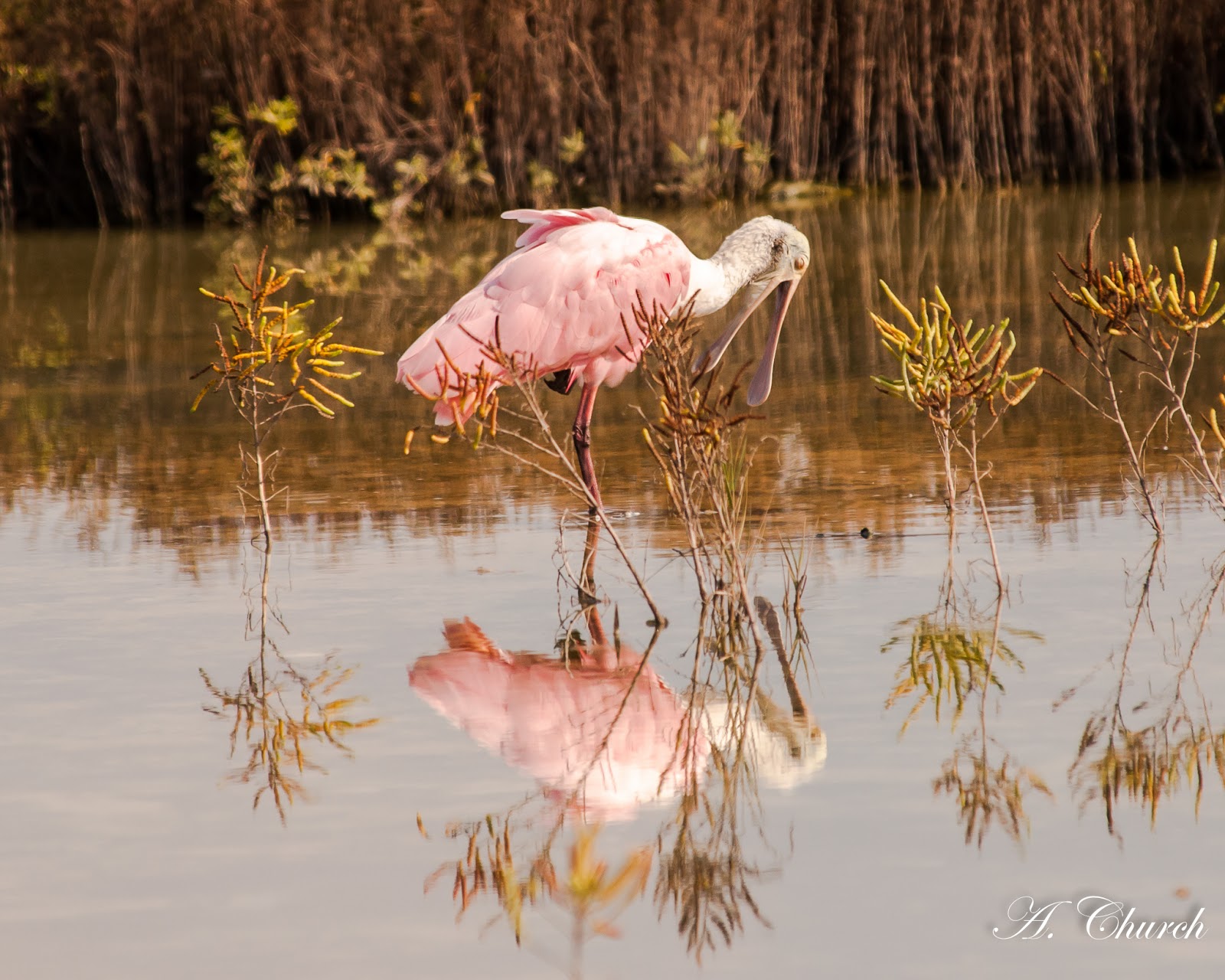
We were extremely lucky that low tide coincided perfectly with sunrise on this day. Low tide was necessary to expose prime feeding grounds for many species of shorebirds, and having it happen at sunrise when the birds are most active was essential. It was here, at Bunche Beach, that we gained a lot of confidence in our ability to break the record. In the hour that we spent at this location, we were able to check off an additional 29 species including a very confused looking immature Yellow-crowned Night-Heron that stared at us for quite a long time. I guess it wasn't used to seeing people on the beach so early in the morning.
Species found at Bunche Beach:
| Northern
Cardinal |
| Black-bellied Plover |
| Yellow-crowned Night-Heron |
| Willet |
| Snowy Egret |
| Semipalmated Plover |
| Great Egret |
| Sanderling |
| Laughing Gull |
| White Ibis |
| Tricolored Heron |
| Black Skimmer |
| Dunlin |
| Great Blue Heron |
| Brown Pelican |
| Least Tern |
| Royal Tern |
| Prairie Warbler |
| Little Blue Heron |
| Osprey |
| Reddish Egret |
| Roseate Spoonbill |
| Short-billed Dowitcher |
| Ruddy Turnstone |
| Wilson's Plover |
| Double-crested Cormorant |
| Barn Swallow |
| Common Ground-Dove |
Fish Crow
|
At 7:00 am we left Bunche Beach very happy with a total of 36 species on our list for the day. Our next stop was the local Publix. Yes, you read that right. We went looking for birds at an urban grocery store. To be more precise, we were aiming for a little-known local birding spot located behind the Publix in an empty lot. Here we were able to find Common Grackle, Boat-tailed Grackle, Red-winged Blackbird, Gray Kingbird, and Great-crested Flycatcher. We did not spend too much time at this location, and quickly moved onto our next stop which happened to be at the local Walmart. We were aiming for a water retention basin located along the edge of the parking lot which we knew would have Muscovy Duck and Rock Pigeon, but we didn't expect to pick up Anhinga here as well! As we were leaving Walmart, Libby spotted a Loggerhead Shrike sitting on a shopping cart that had been ditched in the landscaping. Part of the fun of birding is finding birds in the least expected places!
It was now almost 8:00 am, and we headed off to some residential areas in search of Eastern Bluebirds that we had gotten a tip on a few days before. While cruising through these older neighborhoods with many mature trees we were able to check off Red-bellied Woodpecker, Blue-gray Gnatcatcher, Downy Woodpecker, and Red-shouldered Hawk. Tucked away at the end of one of the streets was a "back" entrance to Six Mile Cypress Slough Preserve. We stopped here for a quick look and ended up finding Glossy Ibis, Lesser Yellowlegs, Mottled Duck, and Blue Jay. I did hear an Eastern Bluebird calling a few times, but Libby did not hear it, and we had decided in the beginning of the day to not officially check off any species that we did not both hear and/or see. We also heard a faint sound that was probably an American Robin, but we could not confirm the identity of the sound, and needed to keep moving.
Our next stop was at the Six Mile Cypress Slough Preserve, but from the "official" entrance this time. As soon as we got out of the Jeep, Libby calls my attention to a hawk that is circling above the parking lot. This was a very lucky observation since the bird disappeared behind the trees seconds after we identified it as a Short-tailed Hawk! Doing a quick walk around the boardwalk added Tufted Titmouse, Carolina Wren, Northern Parula, and Black-crowned Night Heron to our list. Now with 58 species, we headed off to Harnes Marsh Preserve.
Since Libby was driving, it was my job as the co-pilot to keep a sharp eye out for any species that we needed. Many times during the day our conversation would be interrupted by me jabbing frantically at the windshield with my index finger to indicate that I found a "new" species for the day and yelling at Libby to "Pull over! Pull over!". This constant vigilance really paid off on our way to Harnes Marsh, as we added Black Vulture, Turkey Vulture, Swallow-tailed Kite, and Bald Eagle. As soon as we pulled into the parking area of the marsh, we were greeted by Sandhill Cranes parading around making a spectacle of themselves.
 |
| Boat-tailed Grackle showing off his iridescence at Harnes Marsh Preserve. |
We had been hoping for Limpkin at this spot, and Libby had seen them here many times during scouting trips, but they must have been at an out-of-state Limpkin convention on this particular day. Although we walked halfway around the marsh, not a single Limpkin was seen or heard. However, we did manage to find Common Gallinule (previously known as Common Moorhen), Snail Kite (a life bird for me!), American Coot, and a flock of Bobolinks that Libby miraculously picked out of the sky. We took a short break here from the whirlwind of the day to watch the Snail Kite swoop back and forth across the marsh, hunting for juicy snails. When he finally snagged one and perched atop a small evergreen to eat it, we moved on.
 |
| Snail Kite with a snail. |
It was now noon and we were at 68 species for the day. Not too shabby for missing a few target birds, and with most of the migrants already having passed through. Our next stop was at the Alba Scrub Preserve where we were hoping for Northern Bobwhite. Again, we missed our target bird, but did find some very cooperative Red-headed Woodpeckers! As we were leaving the preserve and cruising through a residential area, I saw a dove careen across the road in front of us. I also was positive that I had seen a flash of white in the wing. Libby had not seen the bird well enough to confirm the id, so she pulled over and I jumped out and ran across the road to where I had seen the bird dive into the vegetation. When I re-found the dove, Libby popped out of the Jeep, got her binoculars on the bird, and confirmed it as White-winged Dove. Although this species of dove seems to be everywhere in most of Florida, and are easily seen on any given day, this was the
only one we saw all day.
At this point in the day we had already hit all the "big" birding spots and were spending time driving to specific places where we had been told we could find certain species, and hoping we would pick up the more common species along the way. This worked out fairly well and we picked up European Starling and Cattle Egret on the way to a pond that was supposed to provide us with Wood Ducks. This pond was visible from the road, and was located on private property, so we couldn't walk right up to it. Libby pulled off onto what little shoulder there was on the road and we stared at the pond for many minutes. Not one duck, Wood or otherwise. We moved the Jeep up a few feet to view the pond from a different angle. We waited. No ducks. We were tired, the 3:00 am wake-up call coupled with no real meals was starting to hit us. Libby decided we had waited long enough, and I agreed. She checked her mirrors to pull back out onto the road, and began to ease back onto the road. She looked back at the pond once more, yelled "look!" and immediately pulled back off the road and slammed on the brakes. I looked back at the pond and floating out into the open is a pair of Wood Ducks. Pure luck.
With our optimism and adrenaline renewed, we headed off to a well-known (at least by area birders) stormwater retention pond in Cape Coral where a Eurasian Wigeon had been hanging out for many weeks. On the way I was able to pick a Red-tailed Hawk out of the sky. We had no problems finding the Eurasian Wigeon, and even got to see American Coot chicks for the first time!
Our next stop was a specific clump of vegetation in an abandoned development that was supposed to house a pair of Florida Scrub-Jays. We weren't sure if we could even find the proper "clump", or what an abandoned development might look like. It turned out that the developer had put in the roads and street signs, but never built any houses, so the area had turned into a grassland with named streets laid out in a grid. The Florida Scrub-Jay is classified as threatened, and is usually found in the oak scrub habitat of Florida, so to find them in Cape Coral is very unusual. We parked the Jeep where the birds were supposed to be hanging out and waited. Nothing. Not a peep, not a squawk, not a flutter. Deciding to take a short walk around, we got out of the Jeep and split up. I stayed near the clump of vegetation, and Libby walked down the road a bit. After about 10 intense minutes, I hear Libby say in a very low and nonchalant, yet obviously restrained voice: "I...I found it". At this moment my back was to her, and I knew she had been scanning the tree that was in front of me, so I immediately put my binoculars up and start looking up and down the tree. This is when I hear her say "No, no, look at me, I found it". I turn around. The silly Florida Scrub-Jay is sitting on Libby's head! I could not believe my eyes. What I think Libby meant to say was "It found me". Apparently people feed the Florida Scrub-Jays (even though they aren't supposed to), and they become very tame and accustomed to looking for handouts. Within minutes, the second bird appeared and landed on my head looking for handouts (which they did not get). This moment was definitely the highlight of the day, and one that will be very difficult to beat in future Big Days.
 |
| Florida Scrub-Jay checking the Jeep for treats. |
 |
| Florida Scrub-Jay looking for treats and not cooperating for the "selfie". |
As we left this odd landscape, and said goodbye to our new birdie friends, we were also able to add Eurasian Collared-Dove and Eastern Meadowlark to our day's list bringing the total to 78. Before leaving Cape Coral we drove by the library to see the Burrowing Owls that live there, and zipped by the Pelican Baseball Complex to pick up Monk Parakeet.
 |
| Burrowing Owl in Cape Coral |
 |
| Burrowing Owl family. |
It was now 3:15 pm and time to head back onto Sanibel Island and hope for any birds we could get along the way. Monk Parakeet had put our total up to 80, and we needed to break the record of 86. On our way into Fort Myers, Libby suddenly starts jabbing the windshield with her index finger and simultaneously uttering some grunting and other noises that I assumed were supposed to be words. I took a look at where she was pointing so vigorously and added Cooper's Hawk to the list! It was at this time that we realized that we had somehow managed to not see or hear a single House Sparrow, and here we were with 81 species under our belt for the day. As we navigated through Fort Myers on the way back to Sanibel I did see and hear a few House Sparrows, but Libby was busy making sure she was safely operating the vehicle, so getting her on these birds was impossible. We finally saw our "countable" House Sparrow on a highway sign that was placed over the road. That bird was number 82. Ridiculous.
As we crossed the bridge back onto Sanibel Island, we spotted a soaring Magnificent Frigatebird, and stopped to look for any gulls that we didn't have yet. The search for gulls was futile with so many people causing a commotion on the beach. Our next stop was Sanibel Beach where we found Snowy Plovers, and shortly after that we checked off a whole family of Pileated Woodpeckers! This put us at 85, we only needed one more species to at least tie the record.
 |
| Family of Pileated Woodpeckers on Sanibel Island. |
We had hoped to have over 100 species at this point in the day, but with missing a bunch of our target species, not being able to fully scout many of the areas beforehand, and finding that most migrant species had left already, we were not surprised that we were below our expected number. It was now 5:00 pm and we decided to do a quick walk-through of the Bailey Tract which is part of J.N. "Ding" Darling NWR. The landscape was very quiet. No new birds for the day. It was starting to look like we might not break this record after all. Then we did the wildlife drive auto tour. Not a single peep or flutter. All was quiet, including us. The air in the Jeep was tense, we were both exhausted, on edge, and focusing all our efforts on wishing birds to appear. At the end of wildlife drive is Shell Mound trail. When we got there we could not come to a consensus on whether or not to walk the trail. Libby decided she needed to take a walk to reduce the tension and anxiety that was building by the minute. As we walked the trail, we did so quietly, straining our eyes and ears for any little sound or movement. Then, near the end of the trail, a White-eyed Vireo started singing! We were officially tied with 86 species! While we were looking for the vireo, a Yellow-billed Cuckoo let out a startling call right behind where Libby was standing and then flew up and away. We looked at each other... number 87! We had done it! Sighs of relief. The tension was gone in an instant, and the whole day flashed before us.
We got in the Jeep and I asked where we were going to have a celebratory dinner. Libby looks at me and says: "oh no, we need to break the record by two, not one". So off we go, to a place where Libby swears we can get one more species...Chimney Swift. We walk some trails and I don't see a single Chimney Swift in the air. Libby keeps telling me that there has to be a few around because she sees them every evening. We startle a Coyote that is trying to cross the path in front of us. Still no Chimney Swift. As the sun is setting we stop at the intersection of two paths and stare into the sky hoping to see just one more bird. In the last minutes of daylight, at 8:30 pm, a single Chimney Swift pops out of the glow of the setting sun, flies down the path toward us, circles the tree we were both facing, and continues on its journey. We were stunned for a second. Then Libby celebrated this event by much jumping around and many exclamations of "I told you so!", "I TOLD you there was a Chimney Swift on this island!" I just couldn't believe how lucky we were to be in the right place at the right time, not only for the Chimney Swift, but for a lot of other species we had seen that day.
Team Hawksauce had done it! We had completed our first Big Day together and broken the record for Lee County, FL with 88 species!!! It was FINALLY time for our first real meal of the day, and a well-deserved one at that! We can't wait to do another Big Day in the near future, so stay tuned for more stories of birding adventures to come!
 |
| Celebratory dinner of giant shrimp in the best "sauce" I ever tasted. |