Showing posts with label May. Show all posts

A Big Day in Lee County, Florida - May 17th, 2014

     As explained in my previous post, my friend Libby and I decided to do a Big Day in Lee County, FL. If you are not familiar with what a Big Day is, please refer to my previous post. Although we technically could have started at 12:00 am on our chosen day, we instead decided to get more than a couple hours of sleep and planned to wake up at 3:00 am. "Loosing" these 3 hours did not hurt us at all because there were very few species that we could detect in the overnight hours, and starting out a couple hours before dawn would give us plenty of time to go in search of the nocturnal species.

   After only 4.5-5 hours of sleep, getting up at 3:00 am was not pretty. By the time we were both functional enough to leave the trailer and pack the Jeep with our piles of snacks, drinks, and gear, our official start time had been pushed back to 3:53 am. The goal for the day was to break the previously set Lee County record of 86 species in a 24 hour period. This record was set on Feb. 24, 2013. We knew we had a challenge ahead of us since most of the migrant species had already left Florida for breeding grounds further north, but we were highly optimistic that we could find more than 86 species in one day.
     Our first target species we knew would be easy, so we eagerly headed off to our first stop which was at the Bailey's General Store parking lot. As we were approaching our destination, we heard our first bird of the day! A Chuck-will's-widow was calling incessantly from somewhere behind the general store. We were now officially awake, motivated, and excited to see what the day would bring. Right after hearing the Chuck-will's-widow, we were lucky enough to check off a Mourning Dove, Black-necked Stilt, Green Heron, a calling Killdeer, and a singing Northern Mockingbird in quick succession. We then moved on to a more wooded location and after many intense minutes, checked off a calling Eastern Screech-Owl! It was now 5:30am and we had checked off all the expected nocturnal species on Sanibel Island plus a few others. If things kept going like this all day, we had a very good chance of breaking the record. We had to keep up the pace though, so we headed off to Bunche Beach Preserve in Fort Myers to wait for sunrise.

Libby scoping the mudflats as the sun rises at Bunche Beach.
     We were extremely lucky that low tide coincided perfectly with sunrise on this day. Low tide was necessary to expose prime feeding grounds for many species of shorebirds, and having it happen at sunrise when the birds are most active was essential. It was here, at Bunche Beach, that we gained a lot of confidence in our ability to break the record. In the hour that we spent at this location, we were able to check off an additional 29 species including a very confused looking immature Yellow-crowned Night-Heron that stared at us for quite a long time. I guess it wasn't used to seeing people on the beach so early in the morning.

Species found at Bunche Beach: 
Northern Cardinal
Black-bellied Plover
Yellow-crowned Night-Heron
Willet
Snowy Egret
Semipalmated Plover
Great Egret
Sanderling
Laughing Gull
White Ibis
Tricolored Heron
Black Skimmer
Dunlin
Great Blue Heron
Brown Pelican
Least Tern
Royal Tern
Prairie Warbler
Little Blue Heron
Osprey
Reddish Egret
Roseate Spoonbill
Short-billed Dowitcher
Ruddy Turnstone
Wilson's Plover
Double-crested Cormorant
Barn Swallow
Common Ground-Dove
Fish Crow

     At 7:00 am we left Bunche Beach very happy with a total of 36 species on our list for the day. Our next stop was the local Publix. Yes, you read that right. We went looking for birds at an urban grocery store. To be more precise, we were aiming for a little-known local birding spot located behind the Publix in an empty lot. Here we were able to find Common Grackle, Boat-tailed Grackle, Red-winged Blackbird, Gray Kingbird, and Great-crested Flycatcher. We did not spend too much time at this location, and quickly moved onto our next stop which happened to be at the local Walmart. We were aiming for a water retention basin located along the edge of the parking lot which we knew would have Muscovy Duck and Rock Pigeon, but we didn't expect to pick up Anhinga here as well! As we were leaving Walmart, Libby spotted a Loggerhead Shrike sitting on a shopping cart that had been ditched in the landscaping. Part of the fun of birding is finding birds in the least expected places!
     It was now almost 8:00 am, and we headed off to some residential areas in search of Eastern Bluebirds that we had gotten a tip on a few days before. While cruising through these older neighborhoods with many mature trees we were able to check off Red-bellied Woodpecker, Blue-gray Gnatcatcher, Downy Woodpecker, and Red-shouldered Hawk. Tucked away at the end of one of the streets was a "back" entrance to Six Mile Cypress Slough Preserve. We stopped here for a quick look and ended up finding Glossy Ibis, Lesser Yellowlegs, Mottled Duck, and Blue Jay. I did hear an Eastern Bluebird calling a few times, but Libby did not hear it, and we had decided in the beginning of the day to not officially check off any species that we did not both hear and/or see. We also heard a faint sound that was probably an American Robin, but we could not confirm the identity of the sound, and needed to keep moving.
     Our next stop was at the Six Mile Cypress Slough Preserve, but from the "official" entrance this time. As soon as we got out of the Jeep, Libby calls my attention to a hawk that is circling above the parking lot. This was a very lucky observation since the bird disappeared behind the trees seconds after we identified it as a Short-tailed Hawk! Doing a quick walk around the boardwalk added Tufted Titmouse, Carolina Wren, Northern Parula, and Black-crowned Night Heron to our list. Now with 58 species, we headed off to Harnes Marsh Preserve. 
     Since Libby was driving, it was my job as the co-pilot to keep a sharp eye out for any species that we needed. Many times during the day our conversation would be interrupted by me jabbing frantically at the windshield with my index finger to indicate that I found a "new" species for the day and yelling at Libby to "Pull over! Pull over!". This constant vigilance really paid off on our way to Harnes Marsh, as we added Black Vulture, Turkey Vulture, Swallow-tailed Kite, and Bald Eagle.  As soon as we pulled into the parking area of the marsh, we were greeted by Sandhill Cranes parading around making a spectacle of themselves. 

Boat-tailed Grackle showing off his iridescence at Harnes Marsh Preserve. 

We had been hoping for Limpkin at this spot, and Libby had seen them here many times during scouting trips, but they must have been at an out-of-state Limpkin convention on this particular day. Although we walked halfway around the marsh, not a single Limpkin was seen or heard. However, we did manage to find Common Gallinule (previously known as Common Moorhen), Snail Kite (a life bird for me!), American Coot, and a flock of Bobolinks that Libby miraculously picked out of the sky. We took a short break here from the whirlwind of the day to watch the Snail Kite swoop back and forth across the marsh, hunting for juicy snails. When he finally snagged one and perched atop a small evergreen to eat it, we moved on. 
   
Snail Kite with a snail. 
      It was now noon and we were at 68 species for the day. Not too shabby for missing a few target birds, and with most of the migrants already having passed through. Our next stop was at the Alba Scrub Preserve where we were hoping for Northern Bobwhite. Again, we missed our target bird, but did find some very cooperative Red-headed Woodpeckers! As we were leaving the preserve and cruising through a residential area, I saw a dove careen across the road in front of us. I also was positive that I had seen a flash of white in the wing. Libby had not seen the bird well enough to confirm the id, so she pulled over and I jumped out and ran across the road to where I had seen the bird dive into the vegetation. When I re-found the dove, Libby popped out of the Jeep, got her binoculars on the bird, and confirmed it as White-winged Dove. Although this species of dove seems to be everywhere in most of Florida, and are easily seen on any given day, this was the only one we saw all day. 
      At this point in the day we had already hit all the "big" birding spots and were spending time driving to specific places where we had been told we could find certain species, and hoping we would pick up the more common species along the way. This worked out fairly well and we picked up European Starling and Cattle Egret on the way to a pond that was supposed to provide us with Wood Ducks. This pond was visible from the road, and was located on private property, so we couldn't walk right up to it. Libby pulled off onto what little shoulder there was on the road and we stared at the pond for many minutes. Not one duck, Wood or otherwise. We moved the Jeep up a few feet to view the pond from a different angle. We waited. No ducks. We were tired, the 3:00 am wake-up call coupled with no real meals was starting to hit us. Libby decided we had waited long enough, and I agreed. She checked her mirrors to pull back out onto the road, and began to ease back onto the road. She looked back at the pond once more, yelled "look!" and immediately pulled back off the road and slammed on the brakes. I looked back at the pond and floating out into the open is a pair of Wood Ducks. Pure luck. 
     With our optimism and adrenaline renewed, we headed off to a well-known (at least by area birders) stormwater retention pond in Cape Coral where a Eurasian Wigeon had been hanging out for many weeks. On the way I was able to pick a Red-tailed Hawk out of the sky. We had no problems finding the Eurasian Wigeon, and even got to see American Coot chicks for the first time! 
     Our next stop was a specific clump of vegetation in an abandoned development that was supposed to house a pair of Florida Scrub-Jays. We weren't sure if we could even find the proper "clump", or what an abandoned development might look like. It turned out that the developer had put in the roads and street signs, but never built any houses, so the area had turned into a grassland with named streets laid out in a grid. The Florida Scrub-Jay is classified as threatened, and is usually found in the oak scrub habitat of Florida, so to find them in Cape Coral is very unusual. We parked the Jeep where the birds were supposed to be hanging out and waited. Nothing. Not a peep, not a squawk, not a flutter. Deciding to take a short walk around, we got out of the Jeep and split up. I stayed near the clump of vegetation, and Libby walked down the road a bit. After about 10 intense minutes, I hear Libby say in a very low and nonchalant, yet obviously restrained voice: "I...I found it". At this moment my back was to her, and I knew she had been scanning the tree that was in front of me, so I immediately put my binoculars up and start looking up and down the tree. This is when I hear her say "No, no, look at me, I found it". I turn around. The silly Florida Scrub-Jay is sitting on Libby's head! I could not believe my eyes. What I think Libby meant to say was "It found me". Apparently people feed the Florida Scrub-Jays (even though they aren't supposed to), and they become very tame and accustomed to looking for handouts. Within minutes, the second bird appeared and landed on my head looking for handouts (which they did not get). This moment was definitely the highlight of the day, and one that will be very difficult to beat in future Big Days. 

Florida Scrub-Jay checking the Jeep for treats. 

Florida Scrub-Jay looking for treats and not cooperating for the "selfie".
     As we left this odd landscape, and said goodbye to our new birdie friends, we were also able to add Eurasian Collared-Dove and Eastern Meadowlark to our day's list bringing the total to 78. Before leaving Cape Coral we drove by the library to see the Burrowing Owls that live there, and zipped by the Pelican Baseball Complex to pick up Monk Parakeet.

Burrowing Owl in Cape Coral

Burrowing Owl family. 

     It was now 3:15 pm and time to head back onto Sanibel Island and hope for any birds we could get along the way. Monk Parakeet had put our total up to 80, and we needed to break the record of 86. On our way into Fort Myers, Libby suddenly starts jabbing the windshield with her index finger and simultaneously uttering some grunting and other noises that I assumed were supposed to be words. I took a look at where she was pointing so vigorously and added Cooper's Hawk to the list! It was at this time that we realized that we had somehow managed to not see or hear a single House Sparrow, and here we were with 81 species under our belt for the day. As we navigated through Fort Myers on the way back to Sanibel I did see and hear a few House Sparrows, but Libby was busy making sure she was safely operating the vehicle, so getting her on these birds was impossible. We finally saw our "countable" House Sparrow on a highway sign that was placed over the road. That bird was number 82. Ridiculous. 
     As we crossed the bridge back onto Sanibel Island, we spotted a soaring Magnificent Frigatebird, and stopped to look for any gulls that we didn't have yet. The search for gulls was futile with so many people causing a commotion on the beach. Our next stop was Sanibel Beach where we found Snowy Plovers, and shortly after that we checked off  a whole family of Pileated Woodpeckers! This put us at 85, we only needed one more species to at least tie the record.

Family of Pileated Woodpeckers on Sanibel Island. 

     We had hoped to have over 100 species at this point in the day, but with missing a bunch of our target species, not being able to fully scout many of the areas beforehand, and finding that most migrant species had left already, we were not surprised that we were below our expected number. It was now 5:00 pm and we decided to do a quick walk-through of the Bailey Tract which is part of  J.N. "Ding" Darling NWR. The landscape was very quiet. No new birds for the day. It was starting to look like we might not break this record after all. Then we did the wildlife drive auto tour. Not a single peep or flutter. All was quiet, including us. The air in the Jeep was tense, we were both exhausted,  on edge, and focusing all our efforts on wishing birds to appear. At the end of wildlife drive is Shell Mound trail. When we got there we could not come to a consensus on whether or not to walk the trail. Libby decided she needed to take a walk to reduce the tension and anxiety that was building by the minute. As we walked the trail, we did so quietly, straining our eyes and ears for any little sound or movement. Then, near the end of the trail, a White-eyed Vireo started singing! We were officially tied with 86 species! While we were looking for the vireo, a Yellow-billed Cuckoo let out a startling call right behind where Libby was standing and then flew up and away. We looked at each other... number 87!  We had done it! Sighs of relief. The tension was gone in an instant, and the whole day flashed before us. 
     We got in the Jeep and I asked where we were going to have a celebratory dinner. Libby looks at me and says: "oh no, we need to break the record by two, not one". So off we go, to a place where Libby swears we can get one more species...Chimney Swift. We walk some trails and I don't see a single Chimney Swift in the air. Libby keeps telling me that there has to be a few around because she sees them every evening. We startle a Coyote that is trying to cross the path in front of us. Still no Chimney Swift. As the sun is setting we stop at the intersection of two paths and stare into the sky hoping to see just one more bird. In the last minutes of daylight, at 8:30 pm, a single Chimney Swift pops out of the glow of the setting sun, flies down the path toward us, circles the tree we were both facing, and continues on its journey. We were stunned for a second. Then Libby celebrated this event by much jumping around and many exclamations of "I told you so!", "I TOLD you there was a Chimney Swift on this island!" I just couldn't believe how lucky we were to be in the right place at the right time, not only for the Chimney Swift, but for a lot of other species we had seen that day.         
     Team Hawksauce had done it! We had completed our first Big Day together and broken the record for Lee County, FL with 88 species!!! It was FINALLY time for our first real meal of the day, and a well-deserved one at that! We can't wait to do another Big Day in the near future, so stay tuned for more stories of birding adventures to come!
Celebratory dinner of giant shrimp in the best "sauce" I ever tasted. 


Birding trip to Sanibel Island, Florida - May 14-17, 2014

     Although it was difficult to leave the Biggest Week in American Birding, I was also looking forward to my next adventure which would commence the next day. After arriving home in Pennsylvania on May 13th, I took my friends out to a local restaurant where we ate a delicious dinner, reviewed our experiences at the Biggest Week, and started talking about where our next joint birding adventure may take place. Thunderstorms were rolling by as we ate and talked, but by the time we were ready to head out there was a break in the rain. Thus, I took my friends to a local birding spot where I knew we could at least hear some Whip-poor-wills, if not see them.
     This particular birding spot is also well known for the productive vernal pools and masses of amphibians that like to gather here for breeding. Once I turned onto the dirt road that would take us to the Whip-poor-wills , I noticed some amphibians hopping around in my headlights. They were American Toads (Bufo Americanus), and as we drove down the road we saw about 100 of them! Luckily they were big enough to see as I was driving, so progression to our destination was slow as I navigated around the toads, and wound up stopping quite a bit to remove the stubborn ones from the road.
     By the time we finally got close to the Whip-poor-will spot, another thunderstorm was approaching, and cloud-to-cloud lightning was lighting up the sky at regular intervals. Then the Whip-poor-wills started calling. I pulled off the road and shut off the engine to take in the eeriness that the sound of the birds and the lightning was creating. My friends had never heard a Whip-poor-will "sing" before, so this was a terrific experience for them both!
     It was getting pretty late when we got home, so I quickly re-packed my suitcase and attempted to sleep. My flight to Ft. Myers, Florida wasn't until the afternoon the next day, but my friends and I had plans to go birding the next morning, followed by breakfast, plus I had a 3 hour drive to the airport ahead of me.

     This was the first time I was flying on Southwest, but I had heard good things about it, so I wasn't worried. I was impressed by the general positive attitude that all the Southwest crew had, and everything ran smoothly. The flight itself was made a lot less pleasant by the gaggle of loud woman who got drunker as time went on, and were scream-laughing the whole way. If I closed my eyes, all I could think of is a tree full of upset, screaming large parrots. This in turn kept all the small children from sleeping during the flight, and they all ended up screaming in unison.

Leaving Pittsburgh, PA

     Luckily the flight was only 2.5 hours long with little to no turbulence. We landed 10min ahead of schedule, and my friend Libby picked me up and we were off to Sanibel. Libby was working as an intern for the J.N. "Ding" Darling National Wildlife Refuge, and I was lucky enough to be able to stay with her on the refuge.
     My first birds of the trip were Glossy and White Ibis in the drainage ditches as we left Ft. Myers, and of course White-winged Doves, and Boat-tailed Grackles aplenty. As we approached Sanibel Island, I saw my first Brown Pelicans of the year, a few Osprey, and an assortment of gulls.

     Since Libby had to work for the first two days I was visiting her, I decided to shadow her and go along on all her wildlife and water quality surveys. The first morning we awoke before dawn to do sea turtle nesting surveys on the beach, followed by water quality testing and collection. After a quick stop to grab some lunch we entered the data from the morning and headed out to try to catch some butterflies for a project that Libby was working on.

Sea turtle nesting surveys on Sanibel Beach at sunrise.

Pretty crab! Pretty dead crab.
     On the second day, we were able to "sleep in" a bit since we were doing bird surveys that started a bit later than the sea turtle surveys. The bird surveys were done with audio playback, where the researcher plays the songs of the birds at regular intervals and records how many birds answer. We were specifically targeting Mangrove Cuckoo, Prairie Warbler, and Black-whiskered Vireo. Of course, two of the birds I really wanted to hear or see while I was on Sanibel were the Black-whiskered Vireo and the Mangrove Cuckoo, but neither of them decided to make a single peep the whole time I was there.

A Green Heron on her nest.

These Mangrove Crabs kept startling me when I was looking for birds in the trees.
     By the time the survey was finished it was lunchtime, so we grabbed some food and headed back to the refuge headquarters. I went and explored the gift shop while Libby took care of some things she had to do, and then she used some comp time to take off early so we could go birding. We grabbed our cameras and headed off to Sanibel Beach for some bird photography. Libby also showed me a Chuck-will's-widow nest with eggs! The parent was nowhere to be seen, but we stayed far back from the nest and used our zoom lenses to take a few photos.

Chuck-will's-widow nest.

White Ibis picking sand fleas out of the surf.

Magnificent Frigatebird cruising overhead.

Ruddy Turnstone
     We decided to have an early dinner that night since we had to go to bed very early. Why? Well because we are slightly crazy and decided to do a Big Day in Lee County, FL. A Big Day is 24 hrs of intense birding. The "day" goes from midnight to midnight, and the goal is to see or hear as many species as possible during that time frame. There are records kept of how many species people have seen or heard during a Big Day in a particular area. Big Days can be constrained by country, state, county, township, park, etc. etc. We had decided to do our Big Day in Lee County, FL since it encompasses not only Sanibel Island, but also some good habitat on the mainland. The record number of bird species seen/heard on a Big Day in Lee County, FL was 86. We intended on breaking that record. Libby and I had been planning this Big Day for a few months but she had done most of the scouting since she was the one working in the area. I had scoured eBird reports to figure out what species were being seen where, and I made sure to review some bird calls/songs that I wasn't used to hearing all the time.
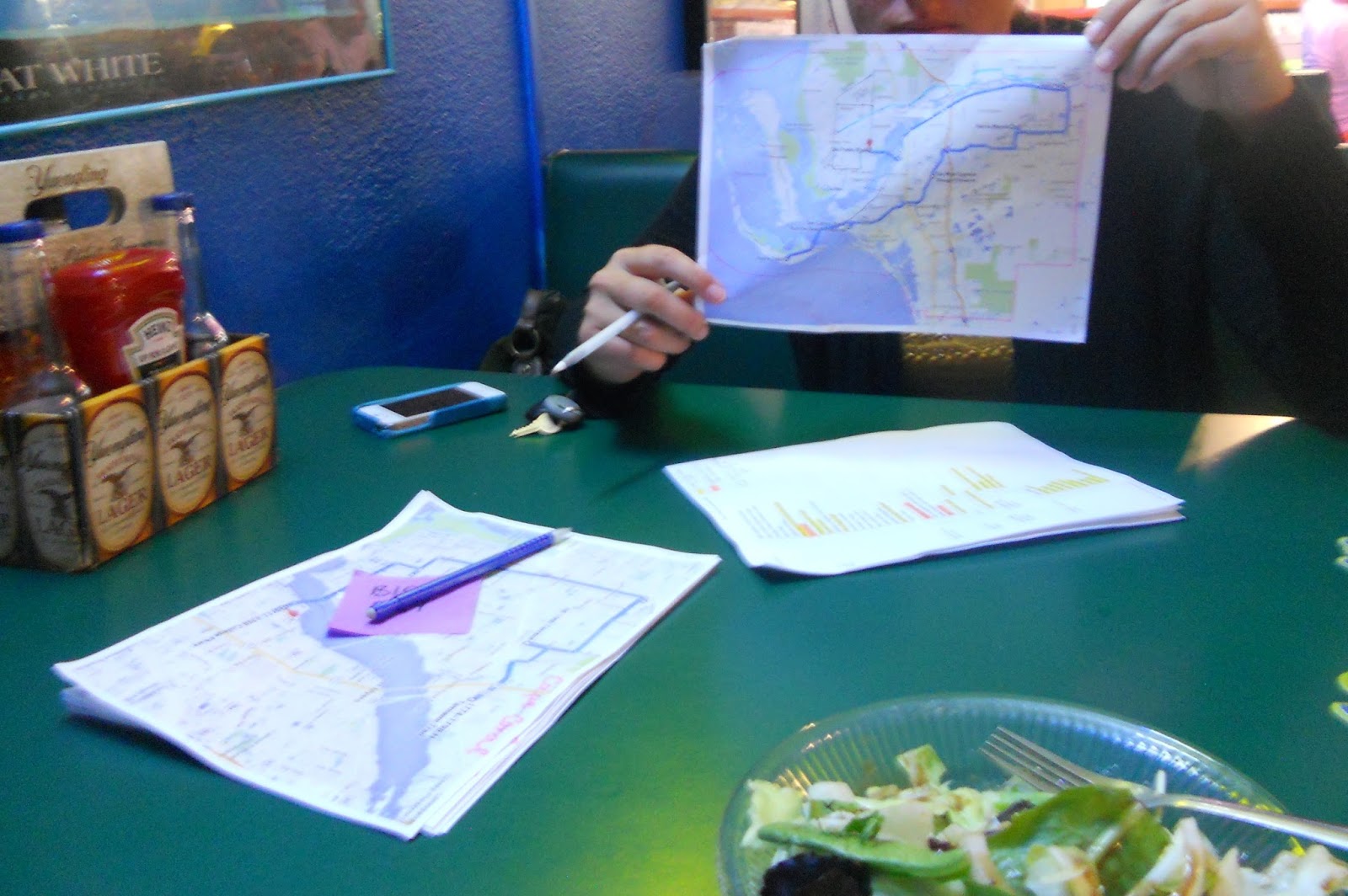
     While waiting for our food to arrive at our table, we laid out all of our route maps, notes, and options so we could create the final route for the Big Day and make any other last minute decisions...such as our team name. We decided on Team Hawksauce. 

Last minute Big Day planning!


....next up....our Big Day!


The Biggest Week in American Birding - Day 5 - May 13, 2014

     On our final morning in NW Ohio we awakened totally exhausted from the previous 4 days of excitement, but were very sad that our time at the festival was coming to an end. With the car packed up, we checked out of the motel around 6am and headed to Magee Marsh for the morning. Due to our exhaustion, we decided to relax a bit and take the time to enjoy the sights and sounds of the festival and the spectacle of bird migration. Being a Tuesday, most of the crowds from the weekend were gone, and moving around the boardwalk was a lot easier. This is not to say that the place was deserted, as there were a fair number of people who were there for the whole week. Birding at a more leisurely pace allowed us to spend more time appreciating and photographing even the more familiar species.

House Wren

Bay-breasted Warbler about to snag some food.

Gray Catbird

Yellow Warbler

Gray Catbird singing in the breeze. 

     Around noon we began to think about getting on the road towards home. However, we were distracted by a last minute text about a Henslow's Sparrow that was spotted along the boardwalk! This bird belongs in grasslands, not on the ground in a marsh. Furthermore, it is not an easy bird to find even in the proper habitat, and would be a lifer for all of us.  We had to go see this bird. Back onto the boardwalk we went, this time re-energized, and speed walking for fear that the bird would disappear before we got to see it. By the time we got to the reported location, there was already a crowd gathering. I promptly found the bird and slipped into a spot among the photographers who were waiting patiently for the bird to hop into a patch of sunlight. The entire time I was also communicating the status of the bird's presence to a friend of mine via cell phone. He was being held up with another activity and to his chagrin could not immediately drop what he was doing to see his lifer Henslow's Sparrow. In the end he did get to see the bird, I got the photo I wanted, and it was all worth the effort!

Henslow's Sparrow

     As we were working on saying our goodbyes to the birds, new friends, and a new favorite birding spot, I happened to see a special sort of bird fly into a tree right alongside the Magee Marsh parking lot not too far from where we were milling about. I immediately got the attention of everyone around me and went looking for the super secretive.....cuckoo!!! It had conveniently perched just above eye-level, and gave the growing crowd of birders decent views before moving further back into the vegetation. We had already seen a Black-billed Cuckoo earlier in the trip, so we were really hoping to get a Yellow-billed Cuckoo before leaving. Luck was on our side this time and this last bird of the trip did indeed have a yellow bill.


Yellow-billed Cuckoo

    Our visit to The Biggest Week in American Birding turned out to be very much worth the trip, and we are already thinking about going again next year! I encourage anyone who has not experienced this festival to drop whatever else you were going to do in the second week of May, and GO!!!!

The official list of all species seen during the festival (as of the day we left). 

Although our time at the Biggest Week was over, my birding adventures for the week were only halfway through. The day after coming home from Ohio I repacked my bags and flew down to Florida to visit a friend who was working on Sanibel Island.....more on this adventure coming soon!

The Biggest Week in American Birding - Day 4 - May 12, 2014

     On our last full day in NW Ohio we didn't want to waste a single minute of daylight, so we were "awake" and packing our gear into the car at 5:30am. The sky was just beginning to lighten, and as usual, I had half my attention devoted to watching for birds that might be flying at this hour. This time I was rewarded with a fly-by Common Nighthawk!
     We headed straight for the Magee Marsh boardwalk with one thing on our minds; to see a Mourning Warbler. This bird is one of the "skulkers", and prefers to stay low to the ground and hidden. A few had been seen during the festival, but we hadn't had any luck with finding one. Arriving at around 6:30am, we were able to get a parking space at the west end of the Magee Marsh parking lot, which was very convenient. Rather than jumping on the boardwalk right away, we elected to check out some of the vegetation around the parking lot and at the beginning of the estuary trail. After a little while some of us began to lose focus - too little sleep and too much to look at will do that - but then we heard our one birding companion say, in a small voice... "ummmmm...what is that?" We wandered over and slowly but surely got our binoculars pointed at the bird she was trying to identify. BINGO!!!! Mourning Warbler! It was very difficult to get a descent photo of this bird due to the fact that it enjoys skulking around in the extreme shade of dense vegetation, and is quite shy. There was a lady nearby who had never seen one before, and a few other interested birders hanging around, so we shared our discovery with them before moving on. Everyone was very grateful that we had found and pointed out the bird to them and thanked us profusely.

Mourning Warbler

Mourning Warbler 

    Happy and re-energized from seeing our target bird, we finally made our way onto the boardwalk to join the hoards of birds and birders. As usual, we had a blast and saw many birds, but we quickly left the boardwalk when a possible Kirtland's Warbler was reported on twitter. This bird is the holy grail of warblers, the rarest of them all. The warbler was spotted at the beginning of the estuary trail, very close to where we had seen the Mourning Warbler earlier in the morning. The sighting was never confirmed, and although about 100 birders stared into the shrubs and trees in that spot for at least 30 minutes, everyone left disappointed.
     Since we hadn't walked the estuary trail yet, we took this opportunity to continue on and see what we could find. The trail had enough birds to keep us entertained, and I did manage to find a Black-billed Cuckoo that conveniently flew into the tree that I just happened to be scrutinizing. At this point we noticed that the sky was darkening, and the threat of getting drenched was imminent.  However, I had a strong feeling that we should go a few more yards down the trail before turning back. I am very glad I followed my instincts this time! Perched and napping on a bare horizontal branch, out in the open, was a Common Nighthawk! We took many photos of this bird, discussed it, and stared at it...but perhaps for too long.

Common Nighthawk 

Common Yellowthroat giving us some attitude. 

 What we should have done was take a few photos and head back to the car. When we finally did start heading back to the parking lot, the sky had darkened considerably, and we could see the downpour heading straight for us. Our binoculars were safe, because they were all waterproof, but between the four of us, we were carrying thousands of dollars of camera equipment. When the big drops began to fall we quickened our pace, but as the rain started coming down harder, we were forced to stop and protect our cameras and lenses with whatever we had. One camera and lens went into someone's backpack, and I ended up taking off my waterproof jacket and wrapping it around my camera and lens. We then made a run for it. It was at this moment that I realized just how heavy my camera and lens could feel. By the time we got to the cars, we were drenched, tired, and cramping, but the camera equipment was dry. Success! No birding trip is complete without a little adventure along the way.
     Thoroughly soaked, we were forced to return to the motel, change into some dry clothes and shoes, and grab some food. By the time all these tasks were completed, the rain had passed, and my friends need to get to a workshop they wanted to attended. I had them drop me off at the Black Swamp Bird Observatory so I could explore the "optics alley", check out the shop, and do some birding around the area. My discoveries during this hour of lone birding included a puddle full of bathing White-crowned Sparrows, a Wilson's Warbler, and very cooperative Yellow Warblers.

White-crowned Sparrows having a great time in a puddle

Yellow Warbler checking me out

Yellow Warbler - if you look very closely you can see that he is color-banded for a scientific study!

     When my friends were done with their workshop, they came to get me. We were milling around the parking lot with some other birders when we got a text saying that the Upland Sandpipers were being seen again. We make an instant decision to try for these birds one more time and bolt for the car. As we were jumping in the car, one of the birders we had met at the festival asked if he could join us, so we shoved our piles of stuff aside and made room for him in the backseat. We called him our orphan birder, and we ended up "adopting" him for a few hours. It took a little while to find the Upland Sandpipers, but with a little knowledge of what kind of habitat they prefer and some help from our orphan birder we finally located them. Such a strange bird, but so worth the search!
     Since we were already out and about, and had adrenaline pumping, we decided to also look for the Black-bellied Whistling Ducks that had been spotted earlier in the day about 15 minutes away. These ducks had appeared at another location along Lake Erie a few days before, but we didn't feel like driving an hour to see them. Luckily, they decided to fly to us instead!

Black-bellied Whistling Ducks


     We spent the next hour or so driving our orphan birder around and showing him quite a few "life birds", which made both him and us very happy. He is not from the United States, so he had not seen many birds that the rest of us take for granted. It would have been fantastic to continue showing him around, but the evening socials at this festival start pretty early, and we had signed up for a special event that evening. The festival was showing a special screening of "A Birder's Guide to Everything", complete with introduction by Kenn Kaufman himself! Kenn not only worked as a consultant for the movie, but he also made an appearance near the end of the film. The cost to see the movie was $10, which was no more than you would expect to spend at a movie theater these days, and 100% of the proceeds goes directly to bird habitat conservation. What a great way to relax after a long day of birding!


Next up...making the most of our last morning at The Biggest Week in American Birding.


The Biggest Week in American Birding - Day 3 - May 11, 2014


     On our 2nd full day in NW Ohio we decided to get up just before sunrise and head out to Pearson Metropark in an attempt to spot the fox kits that were photographed there a few days before. We were not entirely sure where the den was located, but we had a few clues and landmarks to guide us in the proper direction. We had originally pulled into an area of the park which is surrounded by wetlands. Our first bird of the day was a Grasshopper Sparrow which was sitting on top of some tall grasses, in the middle of the parking area, singing his lungs out. We also spotted at least 2 Sora (heard at least 4), some Dunlin, Yellowlegs (lesser and greater), Solitary Sandpiper, and the usual egrets and herons. After walking around for a bit we came to the conclusion that there must be another entrance to the park that would be in more suitable fox habitat so we consulted some maps and drove down the road a bit further.

     The park is much bigger than it looks, so by the time we found the den site the sun was fully risen, and there were many people walking their dogs. No luck seeing the kits, but the trip to the park ended up being a good choice since we were also able to pick up Nashville Warbler, Ruby-throated Hummingbirds, Swainson's Thrush, Veery, and Scarlet Tanager, among others. In the heart of the park is a great little indoor viewing area called Window on Wildlife where visitors can sit either in chairs along a large panel of windows, or back a little further on carpeted steps arranged stadium-style. The windows look out into a small landscaped yard area complete with a medium sized water feature and bird feeders. It was a great place to take a little break and watch the hummingbirds coming in for a drink at the fountain, or to see the Indigo Buntings and Rose-breasted Grosbeaks gorging themselves at the feeders. I also enjoyed watching the Fox Squirrels that come to the feeder since I don't get to see them very often.

Fox Squirrel
Chipmunk stopping to put some fur back in place.

     Once we figured out that we probably had no hope of seeing the fox kits with all the activity around us, the three of us started spreading out and birding an area that seemed to have quite a few warblers flitting around the trees. After about 30 minutes of birding the area and not seeing a whole lot of species diversity, a bird alert text came through on our phones. The Upland Sandpipers and Lapland Longspurs had once again been spotted near Ottawa NWR. My companions were not within comfortable shouting distance, so I face in their direction and start waving my phone in the air in hopes of getting their attention. To my surprise they were doing that exact same thing, only in my direction! "Birder code" is what I call that phenomenon. So we regrouped, piled in the car, and headed off to where the birds were reported.

     When we get to the general area where the birds were reported, there are already random clumps of birders gathered along the road, searching the fields. It would have been helpful if the text alert was a bit more specific, but sometimes the fun is in re-finding the birds with very little direction. After searching a few of the farm fields ourselves, we came upon a cluster of birders who seemed quite animated. Turns out we had hit the jackpot! Eight Lapland Longspurs (LALO) in breeding plumage were in the adjacent field! I had certainly seen LALO before, but always in their non-breeding colors. Wow, were they ever sharp looking! Unfortunately, I was not able to get a photo of these birds, and we never found the Upland Sandpipers that day, but we were happy and felt the chase was a success!

     Since we had some time to kill before lunch, we headed over to Magee Marsh to see how much activity there was in the late morning hours. Of course, things were a bit slower than in the first hours of the day, but birds were still active and numerous enough that boredom was the furthest thing from our minds.

Eastern Screech-Owl (gray morph)

Raccoon people watching 

Blackburnian Warbler

American Redstart
Male Wood Duck calling to his mate.
     At some point we got a text alert that a Golden-winged Warbler (GWWA) had been spotted on the boardwalk. Immediately, there was a stirring among the birders around us, and silently, those "in the know" started walking with a purpose in the direction of the siting. It was almost as though the Pied Piper of Hamelin had started to play his magic pipe, but not everyone could hear it. Luckily, we were in the first wave of people to show up at the location. After a little searching, and following the directions of the masses, the bird was spotted! I was able to get one identifiable photo of the bird before I chose to step back and allow those who hadn't seen it yet to step forward. We hung around the area to see how crazy it could get on the boardwalk when a highly sought-after species was found. All I can say is that it was one of the politest crowds of people I had ever experienced, and I am impressed that the boardwalk held up to that kind of stress and weight.

Golden-winged Warbler

The crowd gathering to see the Golden-winged Warbler

     Eventually we had enough of the GWWA craziness, and our stomachs were yelling at us to get some lunch, so we obliged, once again patronizing the food carts set up in the Ottawa NWR. We didn't feel like we were done with Magee Marsh yet, so we got our food to-go and headed back there for a little picnic on the beach and some relaxing time looking out over Lake Erie. It was then that I saw a Great Blue Heron fly out into the water, land in a place that was clearly too deep for it to stand in, and then awkwardly float/tread water for about 30 seconds. This bird then somehow struggled back up into the air and flew back to where it came from. I still don't know what that crazy bird was thinking or trying to do.


View from our lakeside lunch spot (Photo credit: J. Justesen)

     Around 2pm we got a text saying that there was a White-rumped Sandpiper spotted at the Magee Causeway, and the White-faced Ibis (which we missed on our first day) were once again visible at Metzger Marsh. On the way to Metzger we pulled over quickly where a crowd of birders had gathered along the causeway and took a look for the White-rumped Sandpiper. It was easy to pick out, and we were on our way in less than 5 minutes. The White-faced Ibis at Metzer were also very cooperative, standing out in the open, giving nice views even with just binoculars. We ended up birding Metzger for 2 hrs after seeing the ibis, and took a break in the parking lot at the end of the road for about 30 minutes. Of course, exhaustion had gotten the best of us, so we spent the better part of that 30 minutes laughing hysterically about things that had transpired earlier in the day.

White-faced Ibis


Close-up of the White-faced Ibis taken through the scope. 

     Around 5pm we headed to the festival headquarters at Maumee Bay Lodge to hang out at the evening social for a bit. At some point we decided to take a walk around the grounds and discovered two Orchard Orioles! Around 8pm, exhausted and in dire need of food, we headed back to the lodge in hopes of getting some dinner in their restaurant. We are told that their kitchen had just closed, so we head out on the road in search of some sort of prepared food. Turns out that it is impossible to get food anywhere in NW Ohio after 8pm on a Sunday. This is something that we will remember for a loooong time. After much frustration and getting somewhat lost, we ended up at a Walmart which had a built-in Subway. Ending up at the Walmart was somewhat of a blessing in disguise because we were also able to load up on water, juice, and snacks for the next day since we had already consumed everything we had brought with us.


Stay tuned to find out what adventures Day 4 had in store for us!


The Biggest Week in American Birding - Day 2 - May 10, 2014

     On the morning of our first full day in Ohio we were eager to get out on the boardwalk at Magee Marsh and see some birds! I managed to get dropped off at Magee around 7am (my two friends decided to eat breakfast first), and was immediately distracted by the din of birdsong all around me. I begin to walk around the edges of the parking lot and was absolutely floored by the abundance of Warbling Vireos! Usually I am lucky to see and/or hear one or two in a single place, but here there were 6 or 7 in one tree! As I wandered my way around the parking lot, only stopping to chit-chat with other birders or to check my phone for text updates on rarities, I was adding many species to my morning's list in quick succession.

Magnolia Warbler

Chestnut-sided Warbler

Northern Parula

Cape May Warbler

Palm Warbler


     I finally made my way to the west end of the lot, where a large section of the parking area was roped off due to a nesting Bald Eagle in one of the tall trees. The eagle was sitting in the nest watching people watch birds, and was probably one of the most photographed Bald Eagle nests in the country that week.

Bald Eagle on nest at Magee Marsh

There was also another roped off area on the edge of the parking lot where an American Woodcock had decided to make a nest and was being very patient with the hundreds of eyes and cameras being pointed at her all week.
     As I reached the west entrance of the famed boardwalk, I received news that my friends were done with breakfast and ready to join me, so I stalled there until they arrived. While waiting, I was able to add a few more warbler species to my list since they were showing off right in front of my face. I was also able to finally track down a birder whom I have know about for 4 years, but never met in person! Does that make this birder a "lifer" person?
     I initially was dreading "the boardwalk" because I had seen photos of hundreds of people crammed on it, and I have had bad experiences with many people trying to see one bird. This is why I was pleasantly surprised that 99.5% of the people I encountered on the boardwalk were polite, courteous, and followed the guidelines that the festival had published regarding behavior on the boardwalk. Of course, there was the occasional person with a tripod who insisted on walking through the crowds without bothering to close the legs, and a few issues with gigantic strollers taking up a lot of space, but overall I was able to enjoy myself. I think one of things that helped the crowding situation was that there were plenty of birds to go around! No matter where you looked, there were warblers gleaning insects off the trees and shrubs, or seemingly posing for the firing line of cameras. The only time things got jam packed was when highly sought-after species were spotted such as Golden-winged Warblers or the Henslow's Sparrow that showed up way out of its normal habitat.

This is what happens when a Golden-winged Warbler is spotted on the Magee Marsh boardwalk
(photo courtesy of T. Justesen)

     It isn't just the birds that are fantastic here, the other wildlife is abundant as well! We spotted a few amphibians along the trail, a fox squirrel hanging over the boardwalk, and two male snakes trying to mate with a single female right out in the open.

Snakes mating at Magee Marsh

The wading birds certainly weren't having any trouble fishing, and gave their audience quite the show when they caught a meal that was seemingly too large to swallow, but down the hatch it went anyway. By the time we had reached the opposite end of the boardwalk we had seen more birds then we ever thought possible in one place, with the highlight being my first ever Prothonotary Warblers!!!! In fact, at one point we were having such a great time (i.e. laughing so hard we were crying) that one of the festival participants told us jokingly that if we didn't stop having so much fun he "would have to get the Warbler police".

Prothonotary Warbler

     It was now lunchtime so we left Magee Marsh in search of some food. We quickly realized that due to the lack of eating establishments in the area, finding a restaurant for lunch would take up too much valuable birding time, so we settled for the food trucks that were set up specifically for the festival week at the Ottawa National Wildlife Refuge. The food there turned out to be relatively inexpensive and of decent quality. With our now quieted bellies, we decided to drive around the Ottawa NWR Auto Tour and pick up a few more species for the trip list. The tour turned out to be quite productive with some highlights being Trumpeter Swan, Eared Grebe, and about 300 Dunlin mixed in with other shorebirds.

Lesser Yellowlegs in Ottawa National Wildlife Refuge

American Goldfinch in Ottawa National Wildlife Refuge

     For a few days before reaching the festival we had seen multiple reports on Twitter that there was a flock of American Golden-Plovers in a field near a bait shop called "The Happy Hooker", and this day was no exception. After finishing the auto tour, we decided to go track down these plovers, and arrived at the bait shop around 5pm. The heat shimmer over the surrounding fields was terrible, and trying to look through it for medium-sized shorebirds was nauseating. No luck. However, we had seen some suspicious "lumps" on the far side of one of the fields. As we left the bait shop, and started down the road to the next destination, we re-spotted the "lumps" and decided to check them out, so we pulled down the driveway of an industrial company (which was closed since it was Saturday). Bingo! The American Golden-Plovers had been found! All 52 of them! Other birders passing by had seen us standing there trying to digiscope the birds, and soon we had a crowd gathering. Once everyone had seen the birds through our scope, we got out of there and headed off to attend the festival's evening social.

American Golden-Plovers

     By the time we arrived at the social there was very little to no food left, so after chit chatting with some folks for a bit, we were more than ready to find some dinner. With few restaurant options in the area, we decided to be a little adventurous and try one of the restaurants that was recommended by our strongly opinionated hotel clerk (see previous post for more about her). It was a little tricky to find the place since we ended up driving there in a line of severe thunderstorms that were rolling through the area, but it was well worth the effort. The restaurant is called The Oregon Inn, and is one of the advertised supporters of the Biggest Week. The prices were reasonable, and the amount of food that was served was more than adequate. I had eaten very little all day, so I went for the small portion of their slow-cooked prime rib entree which cost around $13. Apparently their concept of "small" means that it only covers 1/2 of the plate rather than the whole plate. This steak was not only HUGE, but it was perfectly cooked and seasoned, and came with a choice of garnishes, one of which being my favorite- horseradish.
      When we paid our bills I made sure to slip one of the Biggest Week in American Birding calling cards in with my signed credit card slip. These cards are provided by the festival so that participants can leave them at any establishment where they spend money. This lets the local businesses know that birders DO have an impact on the economy, and hopefully gets them on-board with conservation efforts. Less birds means less birders, which means less tourism and less income for surrounding businesses.


Coming up! Our 2nd full day at The Biggest Week in American Birding!